Practical AI for everyday work

Make AI useful in the work you do every day.

We help teams find the repetitive work worth improving, then build and maintain the tools that do it.

Every team has a queue nobody enjoys.

It is the inbox that has to be read and sorted before the real work starts. The documents copied from one system into another. The question that has been answered a hundred times, somewhere nobody can find.

AI is good at exactly this kind of work, but only when it is fitted to how your team actually works, checked by the people responsible for it, and looked after once it is running. That fitting, checking and looking after is what we do.

The kind of work we take on

Examples of the problems we work on. They describe the work, not results for a client.

Document intake

Today
Forms, invoices and applications arrive by email and are typed into another system by hand.
With a tool
A tool reads each document, fills in the fields and flags what it is unsure about.
Who decides
Someone checks the flagged fields before anything is saved.
Support triage

Today
Every message lands in one queue and waits for a person to read, label and route it.
With a tool
Messages are sorted by topic and urgency the moment they arrive, with a suggested first reply.
Who decides
An agent reads the suggestion and decides what is actually sent.
Today
The answer is in a policy, a past ticket or someone's inbox, and finding it takes an afternoon.
With a tool
Ask a question in plain words and get an answer with links to the sources it came from.
Who decides
Answers point to their sources, so anyone can check before relying on them.

Start small. Prove it. Then grow it.

Each stage ends with a decision you make: carry on, change course or stop.

  1. Assess

    We sit with the people who do the work, map it step by step, and choose the one part where a tool would help most.

  2. Pilot

    A small working version, used by a few people on real cases, running alongside the current way of doing things.

  3. Roll out

    When the pilot holds up against the old way, it goes to the whole team, with training and a way to switch it off.

  4. Look after it

    Models, data and processes change. We keep the tool working, and tell you when it is time to change it.

Plain rules about people and data

What we agree before anything is built.

A person decides what matters

We agree up front which steps a tool may complete on its own and which need someone to approve them.

Your data stays where you agree

Before we build, we write down what a tool may read and where it may send it. It does nothing else.

Measured against today

Every pilot is compared with the way the work was done before. If it is not better, we say so.

Nothing you cannot switch off

Each tool has a plain manual fallback, so the work carries on if the tool stops.

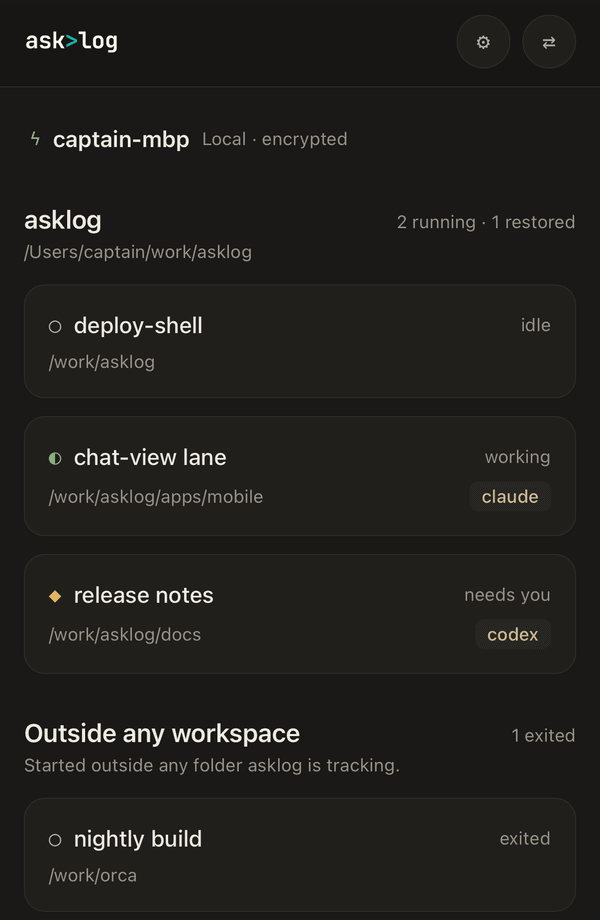
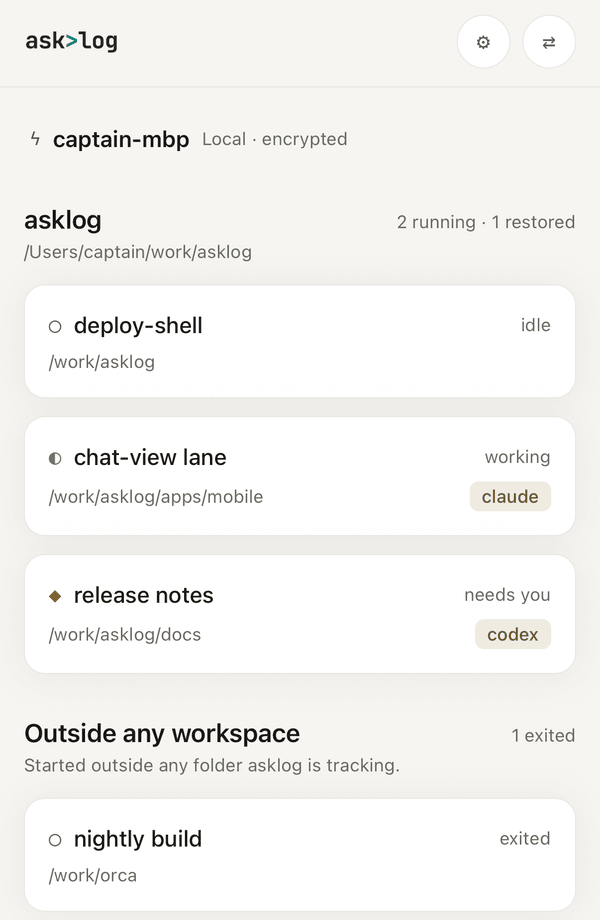
The asklog iPhone app listing coding-agent sessions running on a Mac: a Claude session working and a Codex session waiting for input.The asklog iPhone app listing coding-agent sessions running on a Mac: a Claude session working and a Codex session waiting for input.
The asklog iPhone app, following sessions on a Mac.

Our product

asklog: your coding agents, on your phone.

We build tools for our own work too. asklog lets developers run coding agents such as Claude Code and Codex on their own computers, and pick up the same session from a phone, another computer or a browser.

  • Sessions keep running on your computer when you put the phone down.
  • Every machine on your account, with no SSH to set up.
  • iPhone, Android, Mac, Windows and Linux, from one account.
  • End-to-end encrypted between your device and your machine.

Which part of your week would you hand over first?

Describe the workflow in a few lines. We will reply by email and tell you honestly whether we can help.